Ball Screw Jacks
High-efficiency actuators for precise load positioning — built for continuous duty and harsh industrial environments.

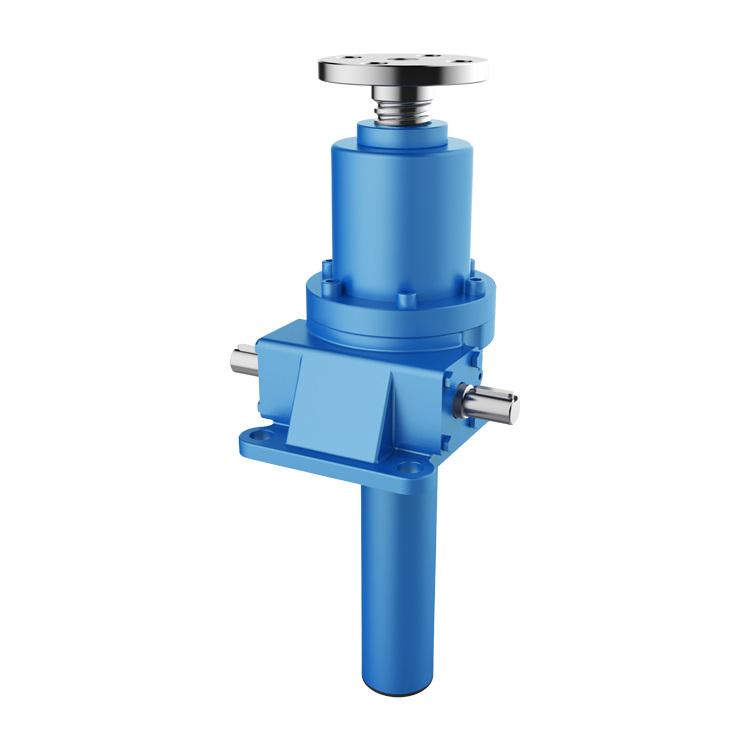
The SJB series ball screw jack is a heavy-duty worm gear linear actuator built for high-speed, precision industrial motion. A precision-ground ball screw assembly, hardened worm gear, and rugged ductile iron housing deliver more than 50% transmission efficiency — far exceeding traditional trapezoidal screw jacks.
Available in 10 standard sizes with load capacities from 0.5 to 50 tons (custom configurations up to 100 tons). Choose translating-screw or rotating-screw designs, upright or inverted mounting, with optional anti-backlash, double-nut preload, protective bellows, and limit switches for critical positioning applications.
Ideal for automated assembly lines, stage lifting equipment, medical devices, steel processing, and OEM machinery. Please note: ball screw jacks are not self-locking — a brake motor or external locking device is required for vertical load holding.
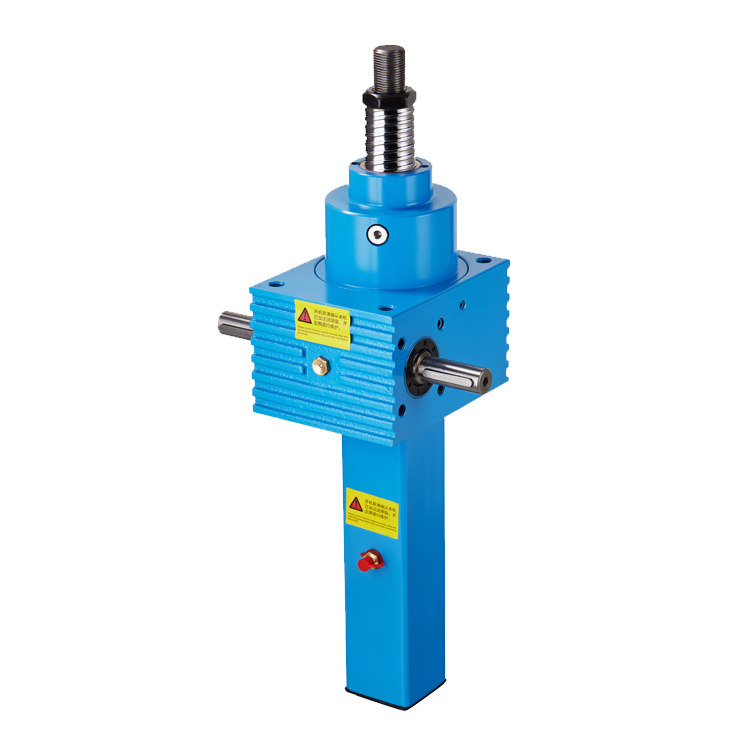
The SJD series is our premium cubic ball screw jack — the primary alternative to leading European brands. Built for high performance and precise positioning, its compact cubic housing enables flexible multi-face mounting in space-constrained installations.
The SJD features a high-precision TBI ball screw, premium tin bronze worm gear (10-1 or 12-2 grade), and precision-ground worm shaft. Compared to the SJB series, its design increases worm gear-to-worm contact area, reducing wear and extending service life. The square-groove housing dissipates heat efficiently, prolonging grease life under continuous duty.
Handling up to 30 tons standalone or in multi-jack synchronized systems, this worm gear ball screw jack suits material handling, steel mill automation, and heavy OEM equipment. Custom accessories available.
Find answers to common questions about ball screw jacks — including how they work, self-locking, load capacities, efficiency, and more. Can’t find what you need? Our engineering team is here to help ( Email:info@sjmotion.com).
A ball screw jack is a mechanical linear actuator that converts rotational motion into precise linear motion. It uses a worm gearbox to drive a precision-ground ball screw, with recirculating steel balls rolling between the screw shaft and ball nut. This rolling-contact design replaces the sliding friction of a traditional machine screw, resulting in much higher efficiency (typically 80-90% at the ball nut), smoother operation, and higher travel speeds.
No. Due to their high efficiency (typically above 50%), ball screw jacks are not self-locking. When power is removed, the load can back-drive and drift. To hold position, you must use a brake motor, an external brake on the input shaft, or another mechanical locking device. This is a critical safety consideration during selection.
The key difference is the friction mechanism. A trapezoidal screw jack uses a sliding trapezoidal thread (metal-on-bronze), offering lower cost and inherent self-locking, but lower efficiency (20-35%) and limited duty cycle. A ball screw jack uses recirculating balls, delivering more than 50% efficiency, higher speeds, longer life, and suitability for high-cycle automation – but it is not self-locking and requires a brake or external locking device. Ball screw jacks also require up to two-thirds less input torque than equivalently rated trapezoidal screw jacks.
Ball screw jacks are available in a wide range, from 5 kN (0.5 ton) for light-duty precision positioning up to 1000 kN (100 tons) for heavy industrial lifting. Common standard sizes include 10 kN, 25 kN, 50 kN, 100 kN, 200 kN, and 500 kN. Custom capacities and stroke lengths can be engineered for specific applications.
The ball screw and nut assembly itself typically achieves 80-95% efficiency. When combined with the worm gear reduction, overall jack efficiency ranges from approximately 45% to 60%, depending on gear ratio and load. This is significantly higher than trapezoidal screw jacks (20-35%), meaning less motor power is needed to move the same load.
Unlike tapezoidal screw jacks, ball screws cannot be keyed – a keyway would interrupt the ball track and cause ball loss. Instead, anti-rotation is achieved by fitting a square anti-rotation tube (square guide block) that slides inside a square stem tube, or by guiding the load externally. Note that adding an anti-rotation device increases required input torque by approximately 8%.
Yes, a ball screw jack can drift after the motor is stopped because it is not self-locking. Drift is influenced by motor inertia, load weight, and gear ratio. To prevent drift and ensure safety, always install a brake of sufficient capacity on the input shaft or use a brake motor. For vertical loads, a holding brake is mandatory.
Ball screw jacks are widely used in: automotive assembly lines (chassis lifting, engine positioning), steel and metal processing (rolling mills, coil handling), packaging and printing machinery, food and beverage equipment, maritime and rail systems, aerospace test rigs, construction formwork, solar tracking systems, and general industrial automation requiring precise, repeatable linear motion.
Thanks to low rolling friction and reduced heat generation, ball screw jacks can handle higher duty cycles than trapezoidal screw jacks – often up to 30-50% in well-lubricated, properly sized applications. Exact limits depend on load, speed, lubrication, and ambient temperature. Continuous operation at high loads may require oil lubrication and thermal monitoring.
– Grease lubrication is standard for most applications. Use a high-quality lithium-based or EP grease suitable for ball screws.
– Relubrication interval: approximately every 100-300 operating hours (reduce to 100 hours under heavy loads or dusty conditions).
– Grease quantity: roughly 1 ml per cm of screw diameter per lubrication point, or until grease slightly escapes from the nut ends.
– Inspection: check for contamination, abnormal noise, or increased backlash every 6 months; keep the screw protected with bellows boots in dirty environments.
Yes. Multiple ball screw jacks can be connected in tandem or multi-jack systems using bevel gearboxes,couplings, and drive shafts to achieve synchronized lifting. With a servo motor and closed-loop control,synchronization accuracy can reach within 0.05 mm. This is commonly used for lifting platforms, stage equipment, and large industrial structures requiring even load distribution.
Standard ball screw jacks operate within -15 to +80 C (5 F to 176 F). Larger or heavy-duty models may extend to +100 C (212 F). For extreme temperatures (cryogenic or high-heat environments), special lubricants, seals, and materials can be specified. High-speed continuous operation may generate additional heat requiring cooling or oil lubrication.
Yes. Common customizations include: special stroke lengths, stainless steel screws and housings for food/corrosive environments, protective bellows boots, custom end fittings (top plate, clevis, plain end, threaded end), integrated position encoders, manual handwheel operation, special gear ratios, and complete multi-jack lifting systems with motors, gearboxes, and controls. In addition, we can completely customize alternatives to any European and American brands according to customer drawings.
Ball screw life is typically calculated based on travel distance (e.g., 50 million revolutions or 10,000-50,000 km of travel, depending on load and lead). Under proper lubrication and within rated load/speed, a ball screw jack can provide many years of reliable service. The worm gearbox, when properly maintained, is often considered lubricated-for-life under normal conditions.
Standard models are typically available with 20-25 days lead time.Custom configurations may require additional engineering and production time. We offer EXW, FOB, and CIF trade terms, and can ship viasea freight for large orders or air freight/DHL express for samples and urgent deliveries. Contact our engineering team with your application specifications for a quotation and lead time estimate.